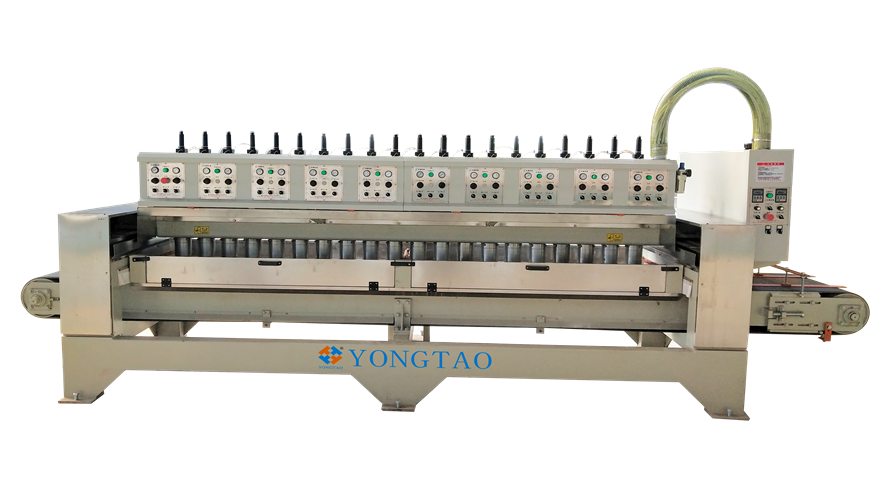
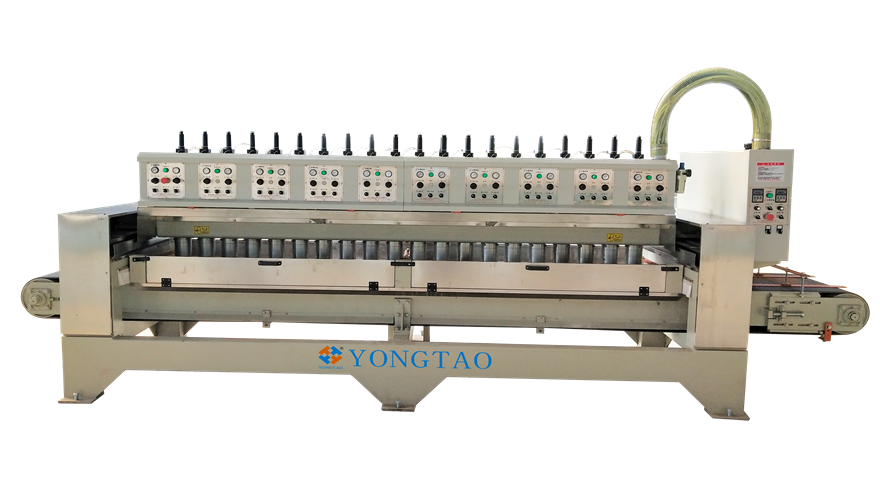
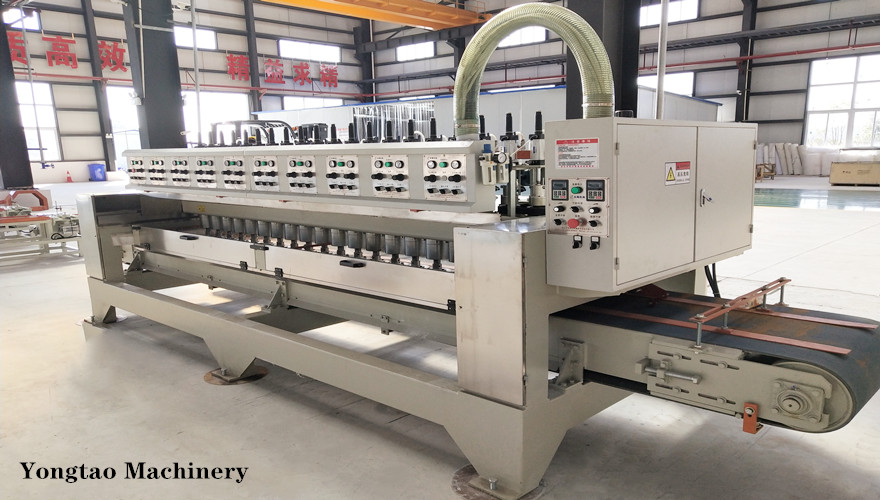
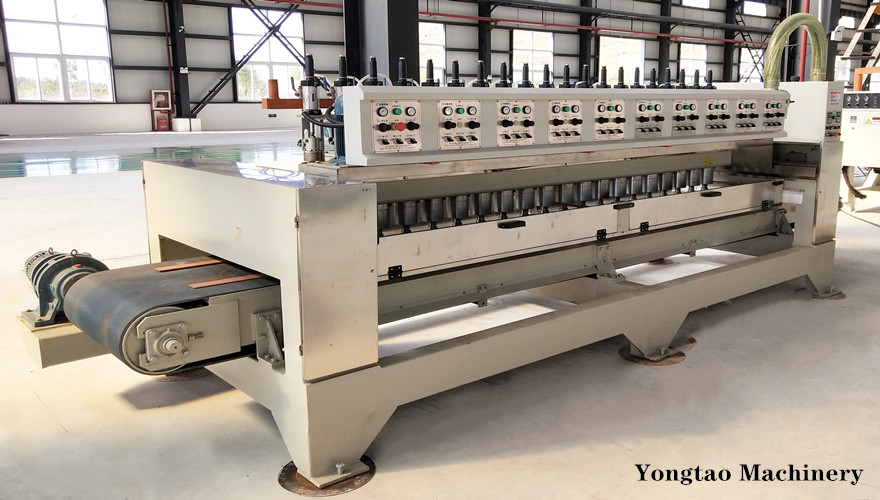
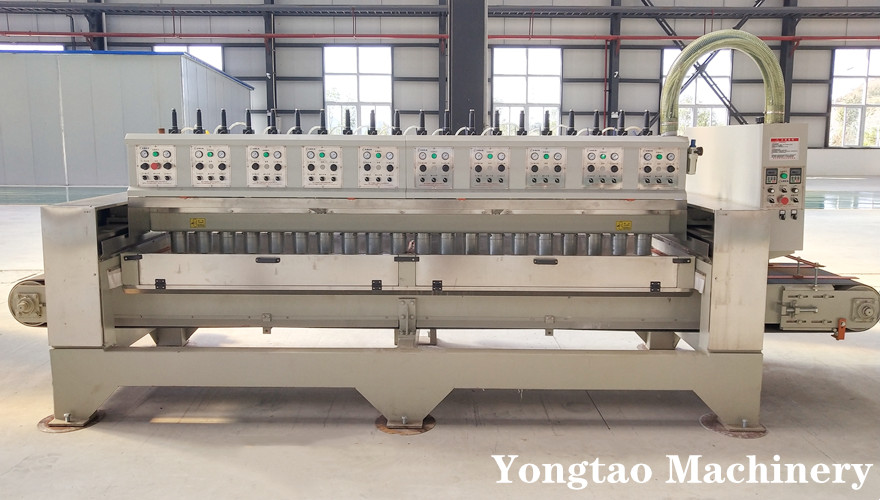
The YSU-400 is a continuous 20 head stone mosaic polishing machine developed for the flat surface finishing of stone mosaic particles, marble mosaic pieces and compatible small-format stone slabs. Its 20-head configuration supports progressive polishing while the conveyor continuously moves the workpieces through the processing area.
The machine has a maximum processing width of 600 mm, an adjustable polishing speed of 0.6–3 m/min and a processing thickness range of 8–50 mm. Small mosaic pieces measuring down to 10 × 10 mm can be processed when they are securely arranged and supported before feeding.
As a stone mosaic flat polishing machine, the YSU-400 is intended for production environments that require continuous feeding, adjustable polishing pressure and repeatable surface-finishing results. It can process compatible marble, natural stone, agate, jade and black cement products after their suitability has been confirmed.
The YSU-400 Mosaic Polishing Machine is used to grind, refine and polish the exposed flat surfaces of stone mosaic particles, marble mosaic pieces and small stone products. It uses 20 polishing heads arranged along a continuous conveyor system to complete successive surface-finishing stages.
Individual small pieces must be securely positioned before entering the machine. Larger mosaic products and compatible small-format slabs can be placed directly on the conveyor when their dimensions and stability meet the feeding requirements.
The YSU-400 is designed for flat-face polishing. It is not intended to polish shaped edges, curved profiles or the internal surfaces of molds.

The YSU-400 can be used as a mosaic particle polishing machine for compatible flat stone and marble particles. The exposed upper surfaces pass beneath the polishing heads while the pieces are supported during conveying.
For very small products, stable positioning is essential. Correct support helps prevent pieces from shifting, tilting or rotating under polishing pressure. The minimum stated processing size is 10 × 10 mm, subject to suitable positioning and sample verification.
As a small mosaic piece polishing machine, the YSU-400 is suitable for batch finishing of compatible pieces with flat exposed surfaces. The arrangement should keep the pieces at a consistent height so that the polishing heads can maintain even contact across the processing area.
The machine is particularly suitable when manual polishing cannot provide the required consistency or production efficiency. Continuous conveying reduces repeated handling between individual polishing stages.
Compatible small stone slabs and marble plates can be fed directly when they are stable, sufficiently flat and within the machine’s 600 mm maximum processing width and 8–50 mm thickness range.
The machine can therefore perform as a small-format stone slab polishing machine for suitable products. Final compatibility depends on the material, original surface condition, dimensions and required finish.
Agate pieces and agate mosaic products can be evaluated for flat surface polishing. Because agate hardness, structure and initial surface condition can vary, representative samples should be tested before confirming the abrasive sequence and production settings.
For suitable applications, the YSU-400 may be configured as an agate mosaic polishing machine or agate piece polishing machine. Processing pressure, conveyor speed, abrasive selection and water supply must be matched to the actual material.
The YSU-400 is designed to process compatible flat products made from:
Stone
Marble
Agate
Jade
Black cement products
Typical workpieces include stone mosaic particles, marble mosaic pieces, small stone plates, small marble slabs and other compatible flat products.
Material inclusion does not guarantee identical settings or final brightness. Stone hardness, density, resin content, original flatness and surface defects can influence the polishing process. Sample testing is recommended before continuous batch production.
Workpieces are placed on the conveyor in a stable arrangement. The conveyor transports them through the polishing area at an adjustable speed of 0.6–3 m/min.
Small mosaic pieces require secure positioning and uniform support. Larger, stable products can be fed directly when their dimensions remain within the specified processing range.
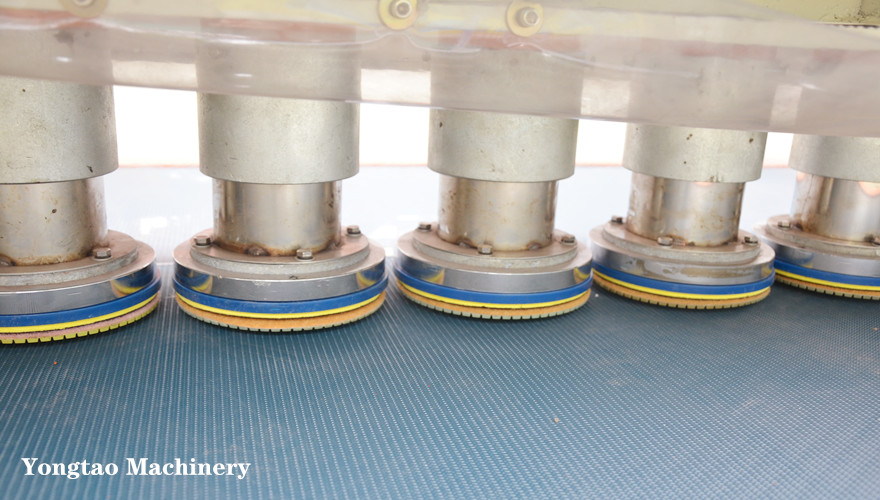
The machine is equipped with 20 polishing heads. As the material travels through the machine, successive heads perform different stages of surface refinement.
A longer polishing sequence allows the production process to move progressively from initial surface correction toward finer finishing. The final result depends on the abrasive arrangement, incoming surface, head pressure, conveyor speed and material characteristics.
The pressure applied by the polishing heads can be adjusted according to the workpiece and processing requirement. Correct pressure helps the abrasive maintain suitable contact with the material surface.
Excessive pressure may increase abrasive wear or affect fragile pieces. Insufficient pressure may reduce material removal and surface uniformity. Settings should be established through sample testing rather than relying on one fixed value for every material.
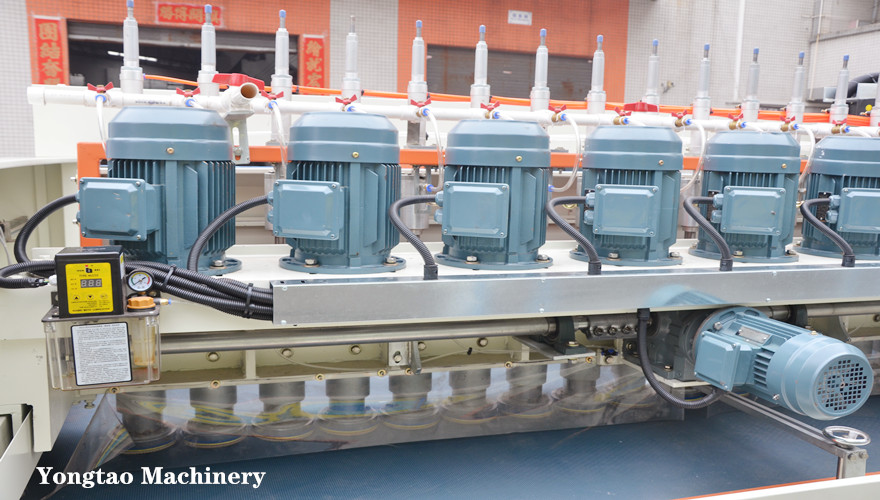
The horizontal movement of the polishing heads is controlled through a gear-driven guide mechanism. This movement helps distribute polishing contact across the working area.
The guide and transmission components require regular lubrication. Suitable grease should be applied according to the machine’s maintenance instructions before operation and during scheduled maintenance.
The 20 Head Marble Mosaic Polishing Machine provides a longer progressive polishing sequence than a machine equipped with fewer heads. Different abrasive stages can be distributed across the available positions according to the incoming surface and required finish.
The main value of the 20-head arrangement is not head count alone. Stable results also depend on:
Correct abrasive selection and sequence
Uniform workpiece thickness and positioning
Appropriate polishing pressure
Suitable conveyor speed
Consistent water supply
Condition of the polishing tools
Lubrication and mechanical adjustment
When these factors are properly controlled, the automatic 20-head mosaic polishing machine can support continuous production with consistent surface-finishing quality.
The machine has 20 polishing heads with a polishing head diameter of Ø150 mm. The multi-head arrangement supports successive surface-finishing stages during one continuous pass.

The effective maximum processing width is 600 mm. The conveyor belt is 700 mm wide, providing the supporting and conveying structure required by the machine.
The conveyor width and processing width are different technical specifications and should not be interpreted as the same value.
The polishing speed can be adjusted from 0.6 to 3 m/min. A suitable speed should be selected according to material hardness, original surface condition, abrasive sequence and required finish.
The stated processing thickness range is 8–50 mm. Workpieces should be sufficiently flat, stable and consistently supported before entering the polishing area.
The continuous feeding arrangement supports batch production of compatible mosaic particles, small stone pieces and small-format slabs. It reduces the repeated manual handling required between individual polishing stages.
| No. | Specification | Parameter |
|---|---|---|
| 1 | Number of polishing heads | 20 pcs |
| 2 | Polishing head diameter | Ø150 mm |
| 3 | Polishing head motor power | Heads No. 1–2: 4 kW; others: 3 kW |
| 4 | Conveyor belt width | 700 mm |
| 5 | Maximum processing width | 600 mm |
| 6 | Processing thickness range | 8–50 mm |
| 7 | Adjustable polishing speed | 0.6–3 m/min |
| 8 | Electric consumption | 24 kW/h |
| 9 | Water consumption | 490 L/min |
| 10 | Air consumption | 50 L/min |
| 11 | Total power | 33.7 kW |
| 12 | Machine dimensions | 5800 × 2200 × 2000 mm |
| 13 | Machine weight | 3500 kg |
Specifications are based on the standard YSU-400 configuration. Electrical supply, workpiece suitability and final production requirements should be confirmed before ordering.
The condition of the material before polishing directly affects the required process. Deep cutting marks, uneven thickness and surface damage may require more initial correction than a prepared flat surface.
Marble, agate and jade do not respond identically to the same abrasive and pressure settings. Material hardness, density and internal structure should be considered when establishing the process.
Small mosaic particles must remain stable during feeding and polishing. Uneven positioning can cause inconsistent head contact, piece movement or variation in the finished surface.
The abrasive stages should progress according to the original surface and target finish. More polishing heads provide additional process positions, but unnecessary stages do not automatically produce better results.
Polishing pressure and conveyor speed must be balanced. A slower speed increases contact time, while a faster speed increases throughput. Neither setting should be selected without considering the material and abrasive condition.
A stable water supply supports cooling and removal of polishing residue. Polishing tools, guides, transmission parts and lubrication points should be inspected regularly to maintain reliable operation.
Before installing the YSU-400, confirm that the production site can provide the required electrical supply, water supply, compressed air, drainage and working space.
Before starting production:
Check the condition and installation of every polishing head.
Confirm that the conveyor area is clean and unobstructed.
Check the water and compressed-air connections.
Apply suitable grease to the specified gear and guide components.
Verify the polishing-head pressure settings.
Set the initial conveyor speed according to the sample material.
Test representative workpieces before batch production.
Operators should follow the supplied operating and maintenance instructions. Guards and protective components must remain correctly installed during operation.
Before selecting the machine, provide the following information:
Material name
Workpiece length and width
Workpiece thickness
Minimum individual piece size
Individual-piece or slab format
Original surface condition
Required surface finish
Expected daily production
Factory voltage and frequency
Photos, drawings and representative material samples can help determine whether the YSU-400 is suitable. Sample testing is particularly important for small mosaic particles, agate pieces and materials with variable hardness or surface conditions.
The machine can polish compatible stone mosaic particles, marble mosaic pieces, small stone plates, small marble slabs and other flat products made from suitable stone, agate, jade or black cement materials.
The stated minimum processing size is 10 × 10 mm. Pieces this small must be securely arranged and supported so they remain stable during continuous feeding and polishing.
The maximum effective processing width is 600 mm. The conveyor belt itself is 700 mm wide. These are two different machine specifications.
The 20-head configuration provides more positions for progressive abrasive stages. This supports continuous refinement from the incoming surface toward the required finish. Final quality still depends on abrasive selection, pressure, speed, water supply and material condition.
Compatible mosaic particles can be processed when they are securely positioned and uniformly supported. Loose pieces should not be fed in an unstable arrangement because they may shift under polishing pressure.
Yes. The YSU-400 can be used as a 20 Head Marble Mosaic Polishing Machine for compatible flat marble particles and pieces. The abrasive sequence and machine settings should be selected according to the marble and required finish.
Compatible flat agate pieces can be evaluated. Because agate varies in hardness and structure, sample testing is recommended before the process settings and expected finish are confirmed.
Yes, compatible small-format slabs can be placed directly on the conveyor when they are stable, sufficiently flat and within the 600 mm processing width and 8–50 mm thickness range.
Provide the material, workpiece dimensions, thickness, smallest piece size, original surface, required finish, expected output and factory electrical supply. Representative photos or samples will support a more accurate technical evaluation.
0086-18665475362
[email protected]
Road 3, Wuzhuang Xiaofengtian Ind. Zone, Luocun Town, Nanhai Dist., Foshan, Guangdong, China