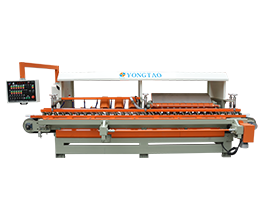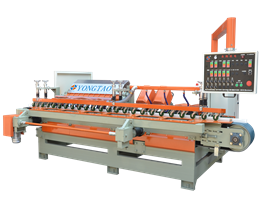
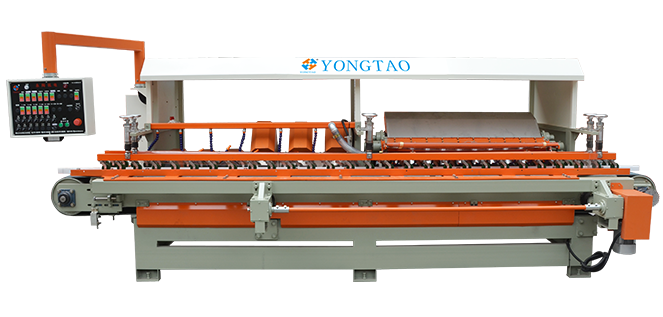
A tile beveling machine is an industrial machine designed to square, chamfer and polish the edges of ceramic and porcelain tiles.Yongtao automatic tile beveling machines combine edge grinding, 45° chamfering and bevel polishing in a continuous process, helping tile factories produce accurate and consistently finished edges.
Also known as a tile chamfering machine, this equipment uses dedicated squaring wheels, chamfering wheels and polishing heads to complete several edge-finishing stages in one pass. Conveyor feeding keeps the tile moving steadily through each processing station, reducing manual handling and improving consistency during batch production.
Yongtao provides ceramic tile beveling machines with different head configurations, processing speeds and automation options. Customers can select an appropriate model according to tile size, thickness, required edge finish, production capacity and factory layout.
A tile beveling machine forms and finishes an angled edge on ceramic or porcelain tiles. During processing, the machine first calibrates or squares the tile edge, then grinds the required 45° bevel and finally polishes the beveled surface.
This integrated process produces a cleaner and more uniform edge than separate manual operations. It is suitable for tile factories and processing workshops that require repeatable bevel dimensions, consistent polishing quality and continuous production.
Tile beveling and tile chamfering are closely related terms. In ceramic tile processing, both commonly describe forming an angled edge. Beveling generally emphasizes the finished sloping surface, while chamfering refers to removing and shaping the sharp corner. Yongtao machines perform both operations together with edge grinding and polishing.
Yongtao currently offers two main 1200 mm tile beveling machine configurations for ceramic and porcelain tile edge processing.
The YTMDP-1200/2+2+10 is equipped with two squaring heads, two 45° chamfering heads and ten bevel polishing heads. It completes edge calibration, bevel formation and polishing during continuous conveyor feeding.
The machine supports tiles up to 1200 mm wide and processes thicknesses from 6 to 20 mm. Its adjustable working speed of 3–9 m/min makes it suitable for continuous ceramic tile beveling and polishing.
The YTMDP-1200/3+3+10 uses three squaring heads, three 45° chamfering heads and ten polishing heads. The additional squaring and chamfering heads provide a more intensive edge-preparation process before polishing.
This model processes tiles from 80 to 1200 mm wide and 6 to 20 mm thick. Its working speed is adjustable from 4 to 8 m/min, making it suitable for batch production of ceramic and porcelain tiles requiring a polished 45° edge.
| Specification | Value |
|---|---|
| Squaring Heads | 2 |
| 45° Chamfering Heads | 2 |
| Polishing Heads | 10 |
| Processing Width | Up to 1200 mm |
| Tile Thickness | 6–20 mm |
| Working Speed | 3–9 m/min |
| Specification | Value |
|---|---|
| Squaring Heads | 3 |
| 45° Chamfering Heads | 3 |
| Polishing Heads | 10 |
| Processing Width | 80–1200 mm |
| Tile Thickness | 6–20 mm |
| Working Speed | 4–8 m/min |
Actual processing results and production speed may vary according to tile material, edge condition, bevel depth, abrasive selection and the required finish.
The squaring heads calibrate the tile edge and remove dimensional irregularities. This step prepares a straight and stable reference edge before chamfering.
Diamond chamfering wheels remove material from the tile edge and form the required 45° bevel. The chamfering depth can be adjusted according to the tile specification and finished-edge requirement.
Multiple polishing heads progressively refine the chamfered surface. This process removes grinding marks and produces a smoother, more consistent bevel finish.
The conveyor carries tiles through each processing station at a controlled speed. Continuous feeding improves production consistency and reduces repeated manual handling between individual processes.
Yongtao tile beveling machines are primarily designed for:
Ceramic tiles
Porcelain tiles
Glazed tiles
Polished tiles
Material hardness, tile thickness, surface coating and edge condition can affect the selection of grinding wheels, polishing abrasives and working speed. Processing tests are recommended when working with new tile materials or special specifications.
Automatic ceramic tile beveling machines can be used for:
Ceramic tile edge squaring
Porcelain tile edge finishing
45° tile chamfering
Bevel edge grinding and polishing
Large-format tile edge processing
Batch production of tiles with consistent beveled edges
Integration with ceramic tile cutting and conveying equipment
Automated tile processing production lines
These machines are suitable for ceramic tile factories, porcelain tile processing plants and industrial workshops that require stable edge quality and repeatable production.
Yongtao industrial tile beveling machines provide:
Integrated edge squaring, chamfering and polishing
Automatic continuous conveyor feeding
Multiple squaring, chamfering and polishing heads
Adjustable processing speed
Support for tiles up to 1200 mm wide
Stable tile positioning during edge processing
Reduced manual handling between processing stages
Compatibility with tile cutting machines and conveyor systems
Configurations for different production requirements
A continuous tile beveling machine can operate as an independent edge-finishing machine or connect with ceramic tile cutting machines, transition conveyors and other handling equipment.
In an integrated production line, tiles can move from cutting to edge squaring, 45° chamfering and bevel polishing with less manual transfer. The final configuration should be selected according to tile dimensions, processing sequence, required output, available factory space and upstream cutting capacity.
When comparing tile beveling machine models, consider the following factors:
Confirm the minimum and maximum tile width and thickness required for production. Both Yongtao 1200 mm models are designed for tiles up to 1200 mm wide and 6–20 mm thick.
The number of squaring, chamfering and polishing heads affects the processing sequence and edge-finishing capacity. Select the configuration according to the incoming edge condition and required finish.
Evaluate the required bevel angle, grinding depth, surface smoothness and dimensional consistency. Trial processing can help confirm the correct grinding wheels, polishing abrasives and machine settings.
Compare processing speed with the output of existing cutting equipment. A balanced production line helps prevent material accumulation between cutting and beveling operations.
If the tile chamfering machine will connect with cutting machines or conveyors, confirm the feeding direction, conveyor height, tile orientation and available installation space.
Check the required electrical supply, compressed air, cooling water, drainage and maintenance access before installation.
Yongtao Machinery manufactures automatic ceramic tile beveling machines for industrial edge processing. Different configurations are available for edge squaring, 45° chamfering and bevel polishing of ceramic and porcelain tiles.
Each ceramic tile chamfering machine can be configured according to tile material, dimensions, required bevel finish, production capacity and factory layout. Customized conveyor connections and production-line configurations are also available for specific processing requirements.
A tile beveling machine is used to square, chamfer and polish ceramic or porcelain tile edges. It forms a controlled angled edge, commonly at 45°, and refines the beveled surface through multiple polishing stages.
The two terms are often used interchangeably in ceramic tile processing. Beveling emphasizes the angled finished surface, while chamfering describes removing and shaping the sharp edge. Yongtao machines combine squaring, chamfering and bevel polishing in one continuous process.
The machines are primarily designed for ceramic and porcelain tiles. Glazed and polished ceramic tiles may also be processed with suitable grinding wheels, polishing abrasives and machine settings. Special materials should be tested before batch production.
Yes. The available configurations combine squaring heads, 45° chamfering heads and multiple polishing heads. Tiles pass through these processing stages during continuous conveyor feeding.
The listed YTMDP-1200 models support tiles up to 1200 mm wide. The exact minimum width should be confirmed for the selected model and feeding configuration.
Both listed models specify a tile thickness range of 6–20 mm. Processing performance may vary according to the material, bevel depth and required edge finish.
Yes. The machine can be integrated with compatible tile cutting machines and conveyor systems. Conveyor height, feeding direction, tile orientation and production speed must be coordinated during line planning.
Tile beveling machine prices depend on the head configuration, processing range, automation requirements, electrical specifications and production-line integration. Customers should provide tile samples, dimensions, required edge finish and expected output to receive an appropriate configuration and quotation.
Contact Yongtao Machinery for automatic tile beveling machine models, specifications, processing tests and quotations. Provide your tile material, size, thickness, required bevel depth and expected production capacity so that our team can recommend an appropriate configuration.
YTMDP-1200/3+3+10 Porcelain Tile 45° Bevel Edge Polishing Machine
The YTMDP-1200/3+3+10 porcelain tile 45 degree bevel edge polishing machine combines three squaring heads, three chamfering heads and ten polishing heads in one continuous process. Designed for porcelain and ceramic tiles from 80–1200 mm wide and 6–20 mm thick, it delivers consistent polished 45° edges at an adjustable working speed of 4–8 m/min.
YTMDP-1200/2+2+10 Ceramic Tile Bevel Edge Polishing Machine
The YTMDP-1200/2+2+10 ceramic tile 45 degree bevel edge polishing machine integrates edge squaring, fixed-angle chamfering and progressive polishing in one continuous process. Its 2+2+10 head configuration produces smooth, consistent bevels while reducing manual handling between stages. Stable conveyor feeding, PU pressure wheels and dual tile supports help maintain reliable processing for standar...
0086-18665475362
[email protected]
Road 3, Wuzhuang Xiaofengtian Ind. Zone, Luocun Town, Nanhai Dist., Foshan, Guangdong, China