

Waterjet processing can separate many metals, stone products, ceramics, glass, composites, plastics, rubber and other non-metallic materials. However, saying that it can cut “almost anything” is not enough for process planning. A material may be technically cuttable but still require controlled piercing, special support, reduced pressure, a water-only stream or preliminary testing.
Material suitability depends on more than the material name. Thickness, hardness, internal stress, brittleness, lamination, porosity, coating condition and required edge quality can all change the result. The correct question is therefore not only “Can this material be cut?” but also “Can it be pierced, supported and processed consistently without unacceptable damage?”
This guide classifies materials as generally suitable, conditionally suitable or normally unsuitable. It also explains how to select between pure-water and abrasive cutting and how to verify an unfamiliar material before production.
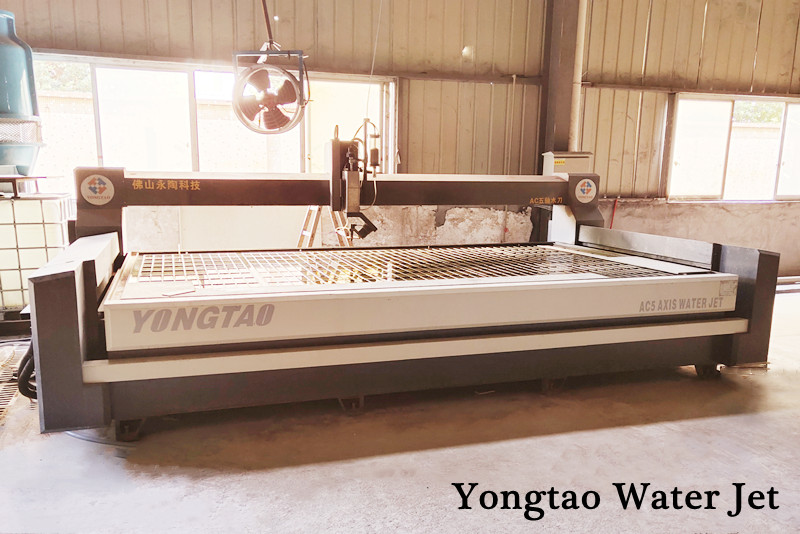
Abrasive waterjet processing is generally suitable for metals, natural stone, engineered stone, ceramic tile, non-tempered glass and many rigid composites. A water-only jet is normally used for softer materials such as foam, rubber, textiles, leather, paper products and some plastics.
Materials requiring additional evaluation include tempered or chemically strengthened glass, highly brittle technical ceramics, honeycomb structures, laminated products, porous stone, moisture-sensitive materials and workpieces containing unknown internal cavities.
Diamond and fully tempered glass are normally considered unsuitable for conventional waterjet cutting. Hazardous, pressurized, reactive or explosive items must never be treated as ordinary workpieces. They require specialist engineering, legal authorization, risk assessment and purpose-designed equipment.
A practical classification is:
Generally suitable:
Metals and alloys
Marble, granite and engineered stone
Porcelain and ceramic tile
Annealed and laminated glass with a verified piercing method
Many rigid plastics and composite sheets
Rubber, foam, leather, textiles and gasket materials
Conditionally suitable:
Brittle technical ceramics
Porous or cracked natural stone
Carbon-fiber and glass-fiber laminates
Honeycomb and sandwich panels
Coated, mirrored or laminated glass
Thin flexible sheet
Moisture-sensitive or water-absorbing products
Materials with residual stress or hidden voids
Normally unsuitable or requiring specialist control:
Fully tempered glass
Diamond
Sealed pressurized components
Unknown explosive or reactive materials
Assemblies containing hazardous internal substances
Workpieces that cannot tolerate water contact or abrasive contamination
The material category determines whether the process should use water alone or water mixed with abrasive particles. These two modes are not interchangeable.
Pure-water cutting uses a concentrated high-velocity stream without added garnet. It is commonly selected for materials that can be separated by the water stream itself.
Typical applications include:
Foam and insulation products
Rubber and gasket sheet
Textiles and woven fabric
Leather and artificial leather
Paper and cardboard
Some food products
Thin soft plastics
Fibrous packaging materials
Pure-water cutting avoids abrasive particles becoming embedded in the workpiece and can produce a narrow cut in soft material. The cutting table, catcher system and work holding must still be selected according to the material. Lightweight or flexible sheets may move, lift or vibrate if they are not supported correctly.
Abrasive cutting introduces garnet or another approved abrasive into the high-speed water stream. The abrasive particles perform most of the material-removal work and allow harder workpieces to be separated.
Typical materials include:
Carbon steel and stainless steel
Aluminum, copper, brass and titanium
Marble, granite and engineered stone
Porcelain, ceramic tile and sintered stone
Annealed glass
Fiber-reinforced composites
Rigid plastics
Cement-based products
Abrasive flow, orifice size, mixing-tube condition, traverse speed and stand-off distance must be matched to the material and thickness. More abrasive does not automatically produce a better edge. Excessive or unstable abrasive delivery can increase operating cost without correcting poor nozzle condition or unsuitable feed settings.
Most common metals are suitable for abrasive waterjet processing because separation is based on mechanical erosion rather than melting. Electrical conductivity, optical reflectivity and melting temperature are not primary restrictions.
Carbon steel and stainless steel can be processed without forming a conventional thermal heat-affected zone along the cut. This is useful when the part specification limits thermal distortion, hardened edges, oxide formation or changes in material properties near the profile.
Thickness influences cutting speed, edge striation and taper. As thickness increases, the jet loses energy while passing through the workpiece, so slower movement may be required. If the programmed speed is too high, the lower edge may show heavy lag lines or incomplete separation.
Waterjet processing does not make every steel job economical. Thin, simple steel profiles may be produced faster by laser, plasma or punching when their thermal effects and edge conditions are acceptable. Waterjet becomes more relevant when the material is thick, the profile is complex, the alloy is heat-sensitive or secondary removal of a thermally affected edge would be costly.
Aluminum, copper and brass are generally compatible with abrasive cutting. Their reflectivity, which may affect some laser processes, does not prevent mechanical erosion by the abrasive stream.
Thin sheets require suitable support because narrow sections may move after being separated from the parent sheet. Operators should also inspect for surface marking, abrasive splash and distortion caused by poor part holding rather than heat.
For copper alloys, the specific alloy, thickness and required edge finish should be confirmed before finalizing the production rate.
Titanium, hardened tool steel and selected high-value alloys may be processed when avoiding thermal alteration is important. The absence of a conventional heat source reduces the risk of localized melting or heat-induced metallurgical change at the cut edge.
These materials can have different machinability even at the same thickness. Cutting data should therefore be validated using the actual alloy grade rather than copied from a generic steel setting.
Natural and engineered stone are common abrasive waterjet materials, especially when the part contains curved contours, internal openings, inlays or shapes that are difficult to produce with a straight saw cut.
Marble and limestone are generally suitable, but they may contain veins, repaired areas, pores or natural cracks. These features can influence piercing stability and may cause local breakage even when the main body of the slab cuts normally.
The operator should inspect both sides of the slab, identify fragile areas and avoid placing an aggressive pierce directly on a visible vein whenever possible. Low-pressure piercing, edge entry or a pre-drilled start hole may reduce risk.
Granite usually requires abrasive cutting because of its hardness and mineral structure. Stable abrasive delivery and appropriate cutting speed are important for controlling the lower edge.
The slab must be supported evenly. Unsupported corners, existing fissures and sudden pressure application can cause damage that is related to material condition rather than basic cutability.
Quartz slabs, engineered stone and sintered stone can be processed, but the exact product structure must be confirmed. Resin content, reinforcement, surface coating, slab thickness and internal stress vary between manufacturers.
Small internal openings and narrow bridges between cut features require particular attention. A suitable lead-in, controlled piercing location and correct cutting sequence help reduce breakage around sink openings, faucet holes and internal corners.
Silica-containing materials also require appropriate control of slurry, settled solids and any dust generated during loading, cleaning or dry handling. Water cutting reduces airborne dust at the cutting point, but it does not eliminate the need for workplace exposure controls.
Some concrete, fiber-cement board and cement-based products can be separated by abrasive waterjet. Suitability depends on aggregate size, reinforcement, porosity and thickness.
Reinforced concrete or products containing steel mesh may cut unevenly because the jet passes through materials with different erosion behavior. Trial cutting is recommended before assuming a stable production rate.
Standard ceramic tile and porcelain tile are normally suitable for abrasive cutting. Technical ceramics require a more cautious evaluation.
Ceramic and porcelain tile can be cut into straight, curved and irregular profiles. The main risks are surface chipping, cracking during piercing and breakage of narrow sections.
Abrasive cutting is normally used, while the piercing pressure and entry method should be selected according to tile hardness and brittleness. The workpiece must lie flat on stable support. A warped tile or tile resting on debris can crack when pressure is applied.
Alumina, zirconia, silicon carbide and other engineered ceramics cannot be grouped together as ordinary tile. Their hardness, fracture behavior and internal stress differ substantially.
Some grades can be cut with suitable abrasive and controlled parameters, while others may crack, chip severely or cut too slowly to be economical. Material grade, hardness, thickness and permissible edge damage should be reviewed before committing to production.
A sample test is essential when the material specification is unfamiliar.
Glass requires classification by treatment and internal stress. “Glass” should never be treated as one universal material category.
Annealed glass is generally compatible with abrasive waterjet cutting when it is properly supported and pierced using a controlled method.
Piercing is usually more critical than contour cutting. Applying full pressure immediately at a stationary point can initiate radial cracks. Reduced-pressure piercing, dynamic piercing, edge entry or a pre-drilled start hole may be used according to the glass thickness and part geometry.
The nozzle should not cross loose fragments, and the support surface should prevent vibration or uneven loading.
Laminated glass may contain polymer interlayers that respond differently from the outer glass layers. Coated or mirrored surfaces may also show local coating damage, delamination or staining.
The operator should confirm:
Glass layer thickness
Interlayer material
Coating location
Acceptable edge appearance
Permitted delamination
Preferred entry side
Piercing method
A representative sample should be inspected before processing the final panel.
Fully tempered glass is normally unsuitable for conventional waterjet profile cutting. Cutting or piercing disturbs the compressive stress pattern and usually causes the panel to fracture into small pieces.
The required shape and openings should normally be produced before the glass is thermally tempered. If the exact glass treatment is unknown, it must be identified before cutting begins.
Plastics range from soft foam to rigid engineering polymers, so stream selection must be based on physical behavior rather than the general word “plastic.”
Acrylic, polycarbonate, PVC, polyethylene and other rigid polymers may be processed with water-only or abrasive cutting depending on thickness and hardness.
Possible concerns include:
Water absorption
Abrasive embedding
Surface scratching
Delamination of multi-layer sheets
Movement caused by jet force
Cracking near unsupported holes
Chemical sensitivity to process water
Test cutting helps determine whether the desired edge can be obtained without excessive frosting, chipping or contamination.
Rubber, foam and gasket materials are commonly processed with a pure-water stream. The main challenge is often work holding rather than cutting energy.
Soft sheets can stretch or deform, while lightweight foam may lift from the table. Vacuum support, clamping, sacrificial layers or another suitable restraint method may be required. The holding method must not compress the material so much that the finished dimensions change after release.
Composite sheets can be suitable, but their layered structure creates risks that are not present in homogeneous metals.
Carbon-fiber-reinforced polymer and glass-fiber-reinforced polymer may be cut using abrasive waterjet when delamination, fiber pullout and moisture entry are controlled.
Piercing through the finished surface may separate layers around the entry point. Edge entry, controlled pressure or a pre-drilled start can reduce the initial load. The finished edge should be inspected for exposed fibers and subsurface delamination, not only overall dimensions.
Cutting slurry and used abrasive may contain resin and reinforcement fibers. Waste handling must follow the material supplier’s safety information and local environmental requirements.
Honeycomb panels and sandwich structures contain layers with different density and stiffness. Water and abrasive can enter internal cells, while thin skins may separate from the core.
Before processing, confirm:
Skin material and thickness
Core material
Adhesive type
Whether water may enter the cells
Permitted delamination
Drying requirements
Support and clamping method
A cut may appear acceptable from the top while hidden separation exists below the surface. Cross-section inspection or another specified validation method may therefore be necessary.
Wood, paper products and textiles may be cut with water, but “cuttable” does not always mean “production-suitable.”
Wood can absorb water, swell, stain or expose internal defects. Paper and cardboard may lose dimensional stability. Textiles can shift or fray if the sheet is not restrained. Some adhesive-backed materials may separate after water exposure.
The decision should be based on acceptable moisture content, drying time, surface appearance and downstream processing—not only whether the jet passes through the material.
Some workpieces need engineering review even if their base material is normally compatible.
Examples include:
Parts with unknown internal cavities
Sealed or pressurized vessels
Previously used chemical containers
Batteries and energy-storage components
Reactive metals or powders
Radioactive or biologically contaminated material
Ammunition, pyrotechnics or explosive devices
Assemblies containing multiple unidentified materials
Waterjet processing must not automatically be described as safe for explosive or flammable items simply because it is a cold-cutting process. High pressure, impact energy, abrasive particles, electrical equipment, static discharge, material reaction and the contents of the workpiece can create additional hazards.
Such tasks require specialist process design, legal authorization, remote operation where applicable and a documented risk assessment. They are outside ordinary workshop cutting practice.
Material name is only the first input. The following factors determine real production suitability.
Greater thickness normally requires a lower traverse speed and increases the possibility of taper and jet lag. Two materials with the same thickness can cut at different rates because their hardness, toughness and structure are different.
Published thickness capability should not be treated as a guaranteed production figure. The practical limit depends on available cutting power, nozzle combination, abrasive delivery, required tolerance and acceptable cycle time.
Brittle or internally stressed materials may crack during piercing even if the jet can cut their main body. Glass, technical ceramics, sintered products and some cast materials should be evaluated for residual stress and edge sensitivity.
Porous stone, cast products, laminates and honeycomb panels can contain weak zones that redirect the jet or trap water and abrasive. Hidden voids can cause inconsistent lower-edge quality.
A material may be technically separated at a high traverse speed but fail the required edge standard. The acceptable result must be defined in terms of taper, striation, chipping, delamination, roughness and dimensional tolerance.
Narrow bridges, small holes, sharp internal corners and closely nested profiles may be more difficult than a simple external contour in the same material. Piercing position and cutting sequence should be planned around the weakest features.
The workpiece must tolerate contact with water, abrasive particles and cutting slurry. Materials used in food, medical, electrical or clean manufacturing applications may have specific contamination restrictions.
Waterjet processing should be selected because it solves a defined manufacturing problem—not simply because the material can be cut.
It is often practical when:
Thermal alteration of the cut edge is unacceptable
The material is reflective or non-conductive
The workpiece is too thick for the preferred laser process
The profile contains curves, holes or irregular contours
Several different materials must be processed on one cutting platform
Near-net shapes can reduce later machining
Close nesting can improve material utilization
The part requires a cut edge without conventional melting or burning
Another process may be more economical when:
The material is thin and suited to high-speed laser or punching
Only simple straight cuts are required
Sawing already meets the accuracy and edge requirement
A very high production rate is more important than material flexibility
The part cannot tolerate water or abrasive contamination
The required micro-features are smaller than the practical jet and kerf size
The final choice should compare the complete production route, including setup, cutting time, consumables, secondary finishing, material yield and inspection—not cutting speed alone.
A controlled sample test is the most reliable way to confirm material compatibility.
Record the material name, grade, supplier, thickness, heat treatment, coating, reinforcement and known internal structure. Do not rely on visual appearance alone.
Check the material safety data, possible reactions with water, contamination restrictions and hazards created by the resulting slurry or particles.
Determine whether the material needs a pure-water stream or abrasive assistance. Confirm that the selected abrasive is compatible with the workpiece and required cleanliness.
Choose stationary, dynamic, low-pressure, edge-entry or pre-drilled piercing according to the material’s brittleness and internal stress.
Use flat, stable support and suitable restraint. The sample should represent the actual production condition, including surface protection and orientation.
The test should include an external contour, an internal feature and any narrow section or corner that is important to the final part. A simple straight cut may not reveal piercing or geometry-related problems.
Evaluate:
Entry-point damage
Lower-edge completion
Kerf taper
Edge striation
Chipping or cracking
Delamination
Abrasive embedding
Dimensional accuracy
Surface marking
Moisture or contamination effects
Document pressure, nozzle combination, abrasive flow, feed rate, stand-off distance, piercing method, material orientation and inspection result. These records create a repeatable starting point for later production.
For a meaningful process evaluation, provide:
Exact material name and grade
Material supplier, if known
Maximum thickness
Maximum workpiece dimensions
Surface coating or protective film
Lamination or reinforcement details
Required part drawing
Smallest hole or internal feature
Required tolerance
Acceptable edge quality
Daily or monthly production quantity
Restrictions on water or abrasive contact
Photographs of cracks, veins, pores or existing defects
This information is more useful than asking only whether a general material category can be cut.
After the material and production requirements have been confirmed, manufacturers can compare suitable 3-axis and 5-axis equipment options for the planned cutting task.
Waterjet processing can separate most common metals, stone, ceramic tile, non-tempered glass, rigid plastics, composites, rubber, foam, leather, textiles and paper products. Hard materials normally require abrasive, while many soft materials can be processed using water alone. Actual suitability depends on thickness, material condition, piercing behavior and edge requirements.
Fully tempered glass and diamond are commonly identified as unsuitable. Sealed pressurized parts, explosive items, reactive materials and workpieces containing unknown hazardous substances must not be processed as ordinary materials. They require specialist evaluation and purpose-designed safety controls.
Normally, no. Cutting or piercing fully tempered glass disrupts its internal stress pattern and generally causes the entire panel to fracture. Holes and profiles should usually be produced before the tempering process.
Most industrial metals and alloys can be cut using an abrasive stream, including carbon steel, stainless steel, aluminum, copper, brass and titanium. However, achievable speed and edge quality depend on alloy grade, hardness, thickness, cutting power and nozzle condition.
No. Soft materials such as foam, rubber, textiles, leather and some thin plastics may be processed with water alone. Metals, stone, ceramic, glass and other hard materials generally require abrasive assistance.
Some brittle materials can be pierced successfully using reduced-pressure piercing, dynamic piercing, edge entry or a pre-drilled start hole. The correct method depends on material type, thickness, residual stress and part geometry. A representative trial cut should be completed first.
There is no single universal thickness limit. Maximum practical thickness depends on the material, available cutting power, nozzle and abrasive combination, required edge quality, tolerance and acceptable production time. Thickness claims should be validated under the actual production conditions.
Many laminated and fiber-reinforced materials can be processed, but piercing may cause delamination and water may enter internal layers or honeycomb cells. The layer structure, adhesive, reinforcement and contamination requirements must be reviewed before production.
No cutting process is completely waste-free. Waterjet processing produces a kerf, removed material, used abrasive and cutting slurry. It can improve material utilization through close nesting and near-net-shape cutting, but waste collection and disposal are still required.
Provide the exact material grade, thickness, dimensions, coating, internal structure, drawing, tolerance and edge-quality requirements. A controlled sample cut should then be inspected for piercing damage, taper, striation, cracking, delamination, contamination and dimensional accuracy before approving production.
This guide was reviewed by the Yongtao Machinery technical team based on industrial waterjet configuration, material test-cut evaluation and cutting-process planning experience. Final parameters should always be verified with the actual material grade, thickness, part geometry and required edge quality.
 0086-18665475362
[email protected]
Road 3, Wuzhuang Xiaofengtian Ind. Zone, Luocun Town, Nanhai Dist., Foshan, Guangdong, China
 0086-18665475362
 [email protected]
 Road 3, Wuzhuang Xiaofengtian Ind. Zone, Luocun Town, Nanhai Dist., Foshan, Guangdong, China
 English
 Español