EN
Industrial Applications of High-Pressure Waterjet Cutting
Yongtao Machinery News and Technical Articles

Industrial Applications of High-Pressure Waterjet Cutting

  Jul 14-2026

High-pressure waterjet cutting is used to produce accurate shapes, openings, profiles and finished parts from materials that may be difficult to process with conventional cutting methods. Typical applications include metal components, stone inlays, ceramic panels, glass shapes, quartz countertop openings, composite parts and customized industrial products.

The most suitable application depends on the material, thickness, required edge quality, part geometry and production volume. Pure water cutting is generally selected for softer materials, while abrasive waterjet cutting is used for harder materials such as metal, stone, ceramic, glass and quartz. A 3-axis system is suitable for most vertical cuts, while a 5-axis system is considered when bevel cutting, angle compensation or more complex edge geometry is required.

This guide focuses on where waterjet cutting is used, which jobs are suitable for the process and what manufacturers should evaluate before selecting a machine configuration.

For a technical explanation of pressure generation, cutting-head operation and abrasive cutting principles, read our high-pressure waterjet cutting technology guide.

High-Pressure Waterjet Cutting Applications at a Glance

High-pressure waterjet cutting supports different production requirements across material-processing industries. The following overview shows the relationship between material type, common cutting tasks and typical configuration requirements.

Metal:

Common applications include machine parts, mounting plates, flanges, brackets, panels, holes, slots and customized profiles. Abrasive cutting is normally required.

Stone:

Common applications include marble and granite inlays, decorative panels, medallions, lettering, countertop openings and irregular shapes. Abrasive cutting is normally required.

Ceramic and porcelain:

Common applications include tile patterns, large-format panel cutting, holes, internal openings and customized decorative pieces. Abrasive cutting and controlled piercing are normally required.

Sintered stone and quartz:

Common applications include sink openings, cooktop openings, faucet holes, curved countertop profiles and customized panel shapes. Material support and suitable lead-in settings are important.

Glass:

Common applications include decorative shapes, holes and special contours in suitable non-tempered glass. Abrasive cutting and controlled piercing are normally required.

Composite materials:

Common applications include carbon-fiber panels, fiberglass parts, industrial laminates and heat-sensitive components. The cutting method must be matched to the material structure.

Soft materials:

Common applications include rubber, foam, gasket material, leather and selected plastics. Pure water cutting may be used when abrasive contamination is not acceptable.


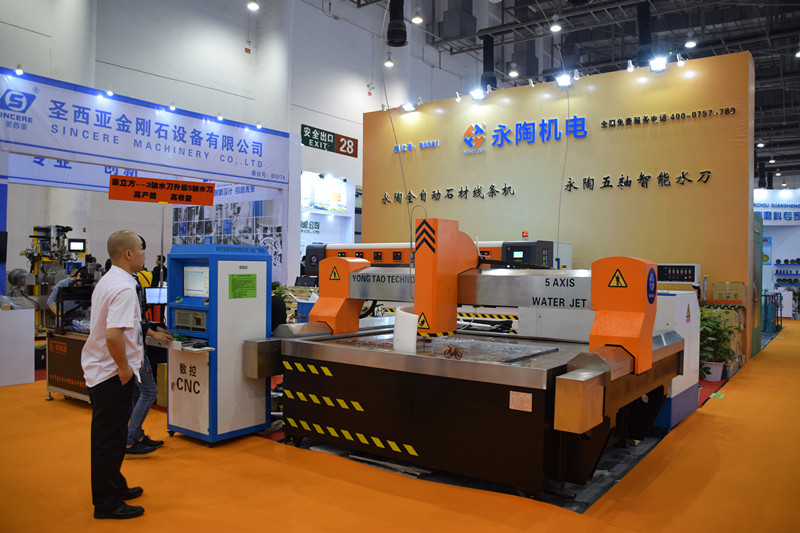
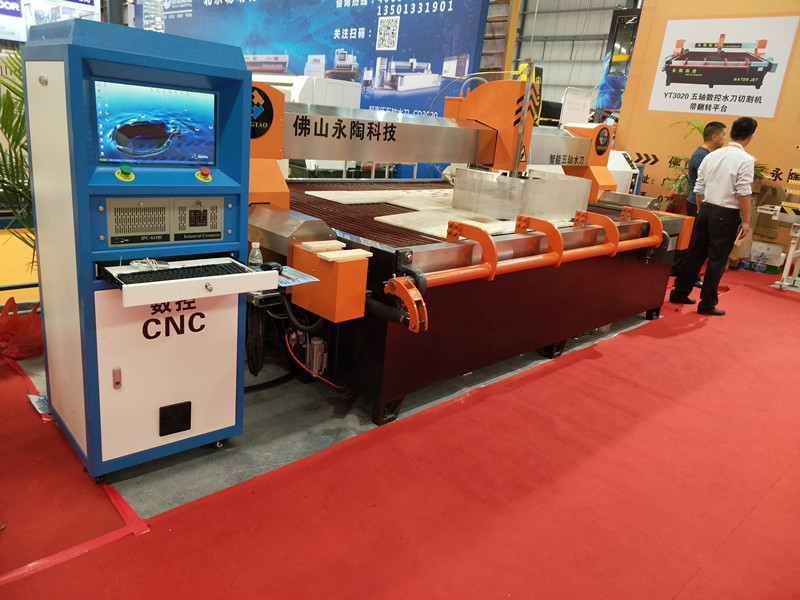
industrial high-pressure waterjet cutting applications

Metal Cutting and Fabrication Applications

Abrasive waterjet cutting is widely used in metal fabrication because it can process different metal grades without creating a heat-affected zone along the cut edge. This makes it useful when the material must retain its original thermal properties or when heat distortion could affect the finished part.

Stainless Steel and Carbon Steel Parts

Typical applications include machine covers, base plates, flanges, brackets, structural profiles, mounting plates and replacement parts. CNC path control allows the same system to produce straight lines, curves, holes and irregular contours from a digital drawing.

For production planning, manufacturers should confirm the plate thickness, smallest hole size, required dimensional tolerance, edge-quality level and whether the part needs additional machining after cutting. Faster cutting may be acceptable for rough blanks, while visible or assembly-critical parts normally require a slower cutting speed and better edge control.

Aluminum, Copper, Brass and Titanium Components

Waterjet cutting is suitable for non-ferrous metals that may be sensitive to heat or difficult to process consistently with some thermal methods. Applications include aluminum panels, copper components, brass decorative parts, titanium profiles and customized alloy pieces.

The process is useful for prototypes, small batches and mixed production because different part geometries can be created by changing the CNC program rather than using a dedicated cutting mold. Material thickness, surface protection, part support and cutting sequence should still be evaluated before production.

Bevels and Weld Preparation

A 5-axis cutting head can be considered when metal parts require angled edges, bevel preparation or taper compensation. This is different from standard vertical profile cutting and requires suitable CNC programming, angle control and machine calibration.

The required bevel angle, material thickness and final welding or assembly condition should be confirmed before selecting the cutting-head configuration. Not every metal application needs five-axis cutting; standard flat profiles are often more efficiently produced with a 3-axis system.


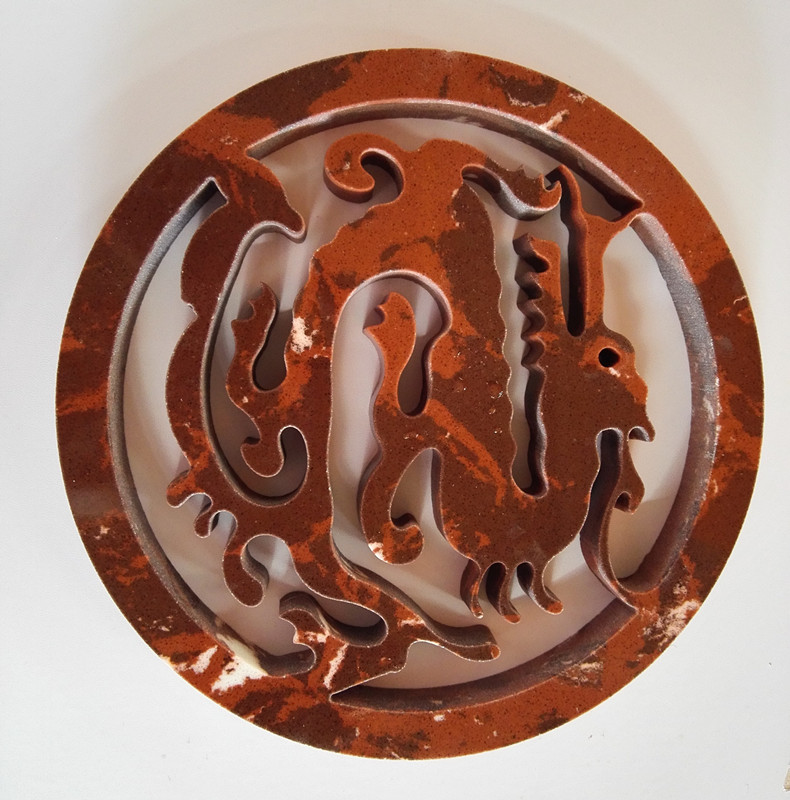
abrasive waterjet cutting metal components

Stone, Marble and Granite Applications

Waterjet cutting is used in stone fabrication when the required geometry cannot be produced efficiently with straight saw cuts alone. It is particularly suitable for curved profiles, internal openings, decorative patterns and components that combine several stone colors or materials.

Stone Inlays, Medallions and Decorative Patterns

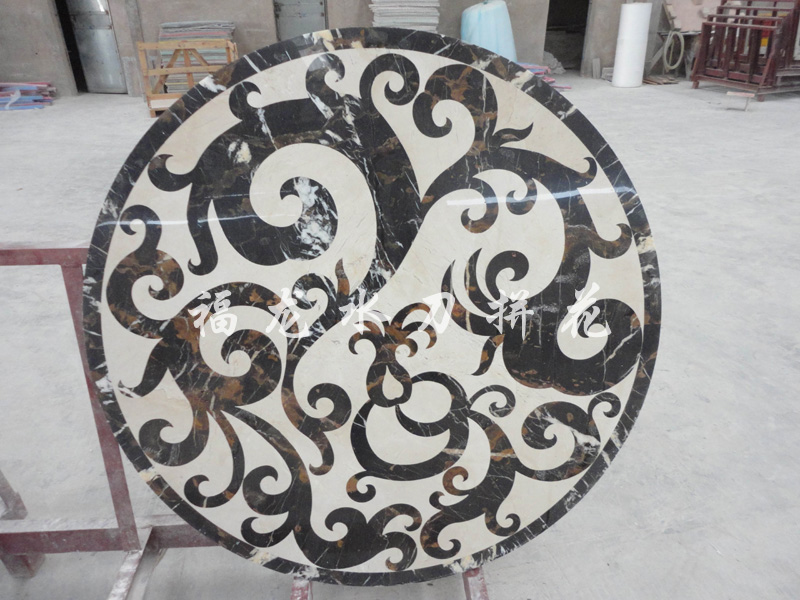
Marble, granite and artificial stone can be cut into curved pieces, letters, borders, logos and decorative components. These pieces can then be assembled into floor medallions, wall panels, hotel decoration, entrance designs and customized stone artwork.

Successful inlay production depends on more than the cutting path. The nesting plan, kerf allowance, part numbering, assembly gap and final polishing method should be considered before cutting. Small decorative pieces may also require careful positioning to prevent movement during processing.

Countertop Openings and Irregular Profiles

Waterjet systems can produce sink openings, faucet holes, curved corners and customized countertop outlines in suitable stone materials. This helps workshops process designs that include internal contours or non-standard geometry.

Before cutting, the operator should confirm the template dimensions, corner radius, edge allowance and installation requirements. Brittle areas around narrow bridges or small holes need suitable support, piercing positions and cutting sequences to reduce the risk of chipping.

Stone Cutting With Three-Axis or Five-Axis Systems

A 3-axis system is suitable for vertical cuts, holes, inlays and most flat stone profiles. A 5-axis system is considered when the job requires angled edges, bevel cutting or a specific edge relationship between the top and bottom surfaces.

The choice should be based on actual finished-product requirements. Selecting additional axes without a clear application may increase operating complexity without improving the result of standard vertical cutting jobs.


waterjet-cut ceramic tile floor medallion

Ceramic Tile, Porcelain and Sintered Stone Applications

Ceramic, porcelain and sintered stone are hard but relatively brittle materials. Waterjet cutting is useful for creating holes, curves and irregular shapes, but stable support and appropriate piercing methods are essential.

Tile Patterns and Decorative Components

Typical applications include tile inlays, mosaic components, border pieces, curved decoration, customized wall panels and floor patterns. CNC cutting helps maintain repeatable geometry when multiple pieces must fit together during assembly.

For pattern production, the CAD drawing should account for kerf width, assembly gaps and the direction of visible surfaces. A test piece is recommended before batch cutting, especially when the design contains narrow sections or sharp internal corners.

Large-Format Porcelain and Sintered Stone Panels

Large-format panels may require openings for sinks, cooktops, switches, pipes and installation hardware. Waterjet cutting can follow programmed contours without using a separate physical template for every shape.

The slab should be fully supported and checked for flatness before cutting. Piercing should be positioned away from critical finished edges whenever possible. Material brand, thickness and internal stress can affect cutting behavior, so production parameters should be confirmed through trial cutting.

Combined Production With Other Stone Equipment

In some workshops, a bridge saw handles long straight cuts, while the waterjet machine produces holes, curves and complex contours. This division of work can be more practical than assigning every cut to one machine.

The production route should be planned according to part geometry, handling requirements and required edge quality. Correct process allocation can reduce unnecessary cutting time and make better use of each machine.


waterjet cutting stone and quartz countertop profiles

Quartz Countertop Fabrication Applications

Quartz countertop fabrication often requires a combination of outside profiling and internal opening work. Common applications include undermount sink openings, top-mount sink cutouts, cooktop openings, faucet holes and curved countertop shapes.

Accurate cutting begins with verified dimensions. The fabricator should confirm whether the drawing represents the finished opening, the sink template or an installation allowance. Corner radii, polishing allowance, seam position and the distance between openings and slab edges should also be checked.

Quartz slabs can react differently according to thickness, resin content and internal stress. A suitable lead-in path, stable support and controlled piercing method help reduce the risk of edge damage. The first finished opening should be measured before the same program is used for batch production.

For quartz, granite, marble and sintered stone applications, manufacturers can explore Yongtao water jet stone cutter configurations for countertop openings, curved profiles and customized stone fabrication.

Glass Cutting Applications and Limitations

Waterjet cutting can produce holes, curves and decorative contours in suitable glass products without applying a thermal cutting process. Potential applications include architectural glass components, furniture glass, decorative panels, mirror shapes and selected industrial glass parts.

However, the glass type must be confirmed before cutting. Tempered glass should not be cut after tempering because machining can cause it to fracture. Glass that will later be tempered should normally be cut and drilled before the tempering process.

Laminated, coated or specialty glass may require application testing. The operator should also consider glass thickness, edge distance, support condition, piercing location and required post-cut edge treatment. A sample cut is recommended when the material specification or internal condition is uncertain.

Composite and Heat-Sensitive Material Applications

Waterjet cutting is used for selected carbon-fiber panels, fiberglass products, reinforced plastics, industrial laminates and other composite materials. Because it is a mechanical cold-cutting process, it can be considered when manufacturers want to avoid heat-related changes near the cut edge.

Composite materials are not all processed in the same way. Layer structure, resin system, reinforcement direction, thickness and susceptibility to delamination can affect the result. Piercing strategy and material support are especially important when water could enter between layers or damage an unsupported surface.

Manufacturers should test the actual material rather than relying only on its general category. The sample should be checked for delamination, edge fraying, surface damage, dimensional accuracy and water absorption before production approval.

Pure Water Cutting Applications for Soft Materials

Pure water cutting uses the water stream without added abrasive. It may be suitable for rubber, foam, gasket materials, leather, paper products and selected plastics.

Typical jobs include gasket profiles, packaging inserts, insulation components, rubber seals and soft material patterns. Because no garnet abrasive is introduced into the cutting stream, pure water cutting can be useful when abrasive residue must be avoided.

The suitability of pure water cutting depends on material density, thickness, flexibility and required edge condition. If the material is too hard or dense, an abrasive process or another cutting method may be required.

Prototypes, Custom Parts and Mixed Production

Waterjet cutting is well suited to production environments that handle changing drawings, small batches or a wide variety of materials. A workshop can modify the CNC program for a new profile without producing a dedicated die for every design.

Typical uses include:

Prototype parts before mass production

Replacement components for older equipment

Customized architectural and decorative pieces

Small batches of metal or stone parts

Samples for customer approval

Mixed part layouts on one sheet or slab

Urgent non-standard cutting jobs

This flexibility is valuable, but every new job still requires a basic process review. The drawing, material, thickness, tolerance, edge requirement, support method and cutting time should be checked before production begins.

When Is Waterjet Cutting a Suitable Choice?

Waterjet cutting should be considered when one or more of the following conditions apply:

The material is sensitive to heat.

The part contains curves, holes or irregular contours.

Different material types must be processed on one cutting platform.

The job requires prototypes or small production batches.

The finished component needs limited thermal distortion.

A physical cutting mold would be inefficient.

The workshop needs flexible CNC-controlled profile cutting.

The process is not automatically the best choice for every job. Long straight cuts may sometimes be completed more efficiently by a saw, while very high-volume identical parts may be better suited to a dedicated production method. The correct decision should compare geometry, material behavior, required quality and production volume.

How to Match the Machine Configuration to the Application

The application should determine the machine configuration—not the other way around. Before selecting a waterjet system, manufacturers should provide the following information:

Material type and grade

Maximum sheet or slab dimensions

Minimum and maximum thickness

Typical part geometry

Smallest holes and internal corners

Required dimensional tolerance

Expected edge quality

Daily or monthly production volume

Need for vertical or angled cutting

Local voltage and installation conditions

A 3-axis machine is generally suitable for vertical 2D cutting, holes, curves and standard profiles. An AB or AC 5-axis configuration should be considered when the product requires bevel cutting, angled edges or more advanced cutting-head movement.

The cutting table must accommodate the largest material normally processed. Pump capacity, abrasive delivery, CNC control and cutting-head configuration should be evaluated as one complete system. A machine selected only from one specification may not match the actual production requirement.

Manufacturers can compare Yongtao water jet cutting machine configurations for different materials, processing sizes, production requirements and 3-axis or 5-axis cutting applications.

Application Testing Before Machine Selection

A sample-cut evaluation is one of the most reliable ways to confirm whether a proposed configuration matches the application. The customer should provide the actual material or a representative sample together with the required drawing and quality standard.

The finished sample should be checked for:

Dimensional accuracy

Top and bottom edge condition

Kerf taper

Surface striations

Chipping or cracking

Delamination in composite materials

Small-hole quality

Corner quality

Required secondary finishing

Testing is especially important for brittle stone, sintered panels, specialty glass, thick metal, composite materials and products with narrow or detailed geometry. The result can help determine suitable cutting parameters and whether a 3-axis or 5-axis system is required.

Yongtao Application and Configuration Support

Yongtao develops and supplies water jet cutting machines for industrial material processing. Available configurations include 3-axis systems for vertical profile cutting and 5-axis systems for applications that require angled movement or bevel cutting.

Before recommending a configuration, Yongtao reviews the customer’s material, maximum size, thickness, drawing, required cutting angle, expected output and workshop conditions. Customers can also provide product drawings or material samples for application discussion.

This application-based selection process helps match the cutting table, high-pressure pump, CNC system, cutting head and supporting equipment to the actual production task. Installation guidance, operator training and spare-parts support can also be planned according to the selected system and destination.

FAQ About High-Pressure Waterjet Cutting Applications

What are the main industrial applications of high-pressure waterjet cutting?

The main applications include cutting metal parts, stone inlays, ceramic panels, quartz countertop openings, suitable glass shapes, composite components and customized industrial profiles. It is commonly selected for jobs that contain holes, curves, irregular contours or heat-sensitive materials.

What materials can be processed by abrasive waterjet cutting?

Abrasive waterjet cutting can process many hard materials, including stainless steel, carbon steel, aluminum, copper, titanium, granite, marble, ceramic, porcelain, sintered stone, quartz and suitable glass. The actual result depends on material thickness, internal structure, cutting parameters and required edge quality.

What is pure water cutting used for?

Pure water cutting is mainly used for softer materials such as rubber, foam, gasket material, leather, paper products and selected plastics. It does not add garnet abrasive to the cutting stream.

Is waterjet cutting suitable for metal fabrication?

Yes. Abrasive waterjet cutting is suitable for metal plates, machine parts, brackets, flanges, panels, holes and customized profiles. It is particularly useful when the manufacturer wants to avoid a heat-affected zone along the cut edge.

Can a waterjet cut granite, marble and quartz?

Yes. Abrasive waterjet systems can cut suitable granite, marble, quartz and artificial stone. Common applications include decorative inlays, medallions, countertop openings, curved profiles and special-shaped components.

Can waterjet cutting process porcelain and sintered stone?

Yes, but porcelain and sintered stone require stable material support, suitable piercing positions and controlled cutting parameters. Trial cutting is recommended because thickness, slab structure and internal stress may affect the result.

Can tempered glass be cut with a waterjet?

Tempered glass should not be cut after tempering because the machining process can cause the glass to fracture. Glass parts that require holes or shaped edges should normally be cut before tempering. Other specialty glass products should be evaluated through sample testing.

Is a 3-axis waterjet suitable for most applications?

A 3-axis system is suitable for most vertical 2D cutting tasks, including straight cuts, curves, holes and irregular profiles. A 5-axis system is considered when the finished part requires bevel cutting, angled edges or advanced taper compensation.

When should a manufacturer request sample cutting?

Sample cutting is recommended for unfamiliar materials, brittle slabs, specialty glass, composite panels, thick materials, small detailed parts and products with strict edge-quality requirements. It provides direct evidence of whether the proposed system can meet the application.

What information is needed to recommend a waterjet configuration?

The supplier needs the material type, maximum size, thickness, drawing, required tolerance, edge-quality standard, cutting angle, expected production volume and local voltage. These details help determine the suitable table size, axis configuration, pump and cutting head.

Discuss Your Waterjet Cutting Application

Every cutting application has different requirements. Material type, thickness, geometry, edge quality, production volume and cutting angle should be reviewed together before a machine configuration is selected.

Send Yongtao your material information, maximum processing size, sample drawing and expected output. The technical team can help compare suitable 3-axis or 5-axis waterjet configurations and determine whether application testing is recommended.


Contact Us