Stone is widely used in residential interiors, commercial buildings, architectural decoration and customized construction projects. Before a raw slab becomes a finished countertop, wall panel, stair step or decorative molding, it normally passes through several processes, including cutting, shaping, opening, grinding and polishing.
Each stone application has different requirements. Straight architectural panels require accurate dimensions and clean edges, while kitchen countertops may require sink cutouts, curved corners, edge profiles and 45-degree joints. Decorative stone lines require consistent profile forming and polishing over the complete length of the workpiece.
Yongtao stone processing equipment is applied to marble, granite, quartz, engineered stone and other decorative materials. Our machines support slab sizing, countertop fabrication, waterjet cutting, edge finishing, stone molding and surface polishing applications.
This page introduces the main applications of Yongtao equipment in the stone industry and explains how different processes are used to manufacture finished stone products.
A stone cutting machine is one of the most widely used types of equipment in stone slab processing. It is used to cut marble, granite and quartz slabs to the required dimensions before cutout processing, edge profiling or surface finishing.
Typical slab-cutting applications include:
Kitchen countertop blanks
Bathroom vanity panels
Stair steps and risers
Window sills
Wall cladding panels
Flooring slabs
Tabletops
Door panels
Architectural stone components
Accurate slab sizing helps maintain consistent finished dimensions and reduces the amount of material that must be removed during later grinding and polishing.
For natural marble and granite, the operator must also consider vein direction, color variation, visible patterns and natural cracks. A suitable cutting layout helps improve material utilization and prevents important openings or corners from being positioned close to weak sections.
In book-matched marble and continuous-vein wall applications, the cutting direction directly affects the final visual result. The slab sequence and pattern orientation should therefore be confirmed before production begins.

Stone countertops are used in kitchens, bathrooms, hotels, restaurants, offices and commercial interiors. Their production normally combines several processing stages rather than relying on one cutting operation.
Common countertop applications include:
Kitchen worktops
Bathroom vanity tops
Island countertops
Bar counters
Reception desks
Restaurant service counters
Dining tables
Commercial display surfaces
A typical countertop may require dimensional cutting, sink openings, faucet holes, curved corners, edge grinding, polishing and miter processing.
Countertop dimensions must match cabinets, walls, sinks and appliances. Accurate positioning is therefore especially important when processing customized residential and commercial projects.
Straight blade cutting is normally used to prepare the basic countertop shape. CNC-controlled or waterjet processing can then be applied to internal openings, rounded corners and irregular contours.
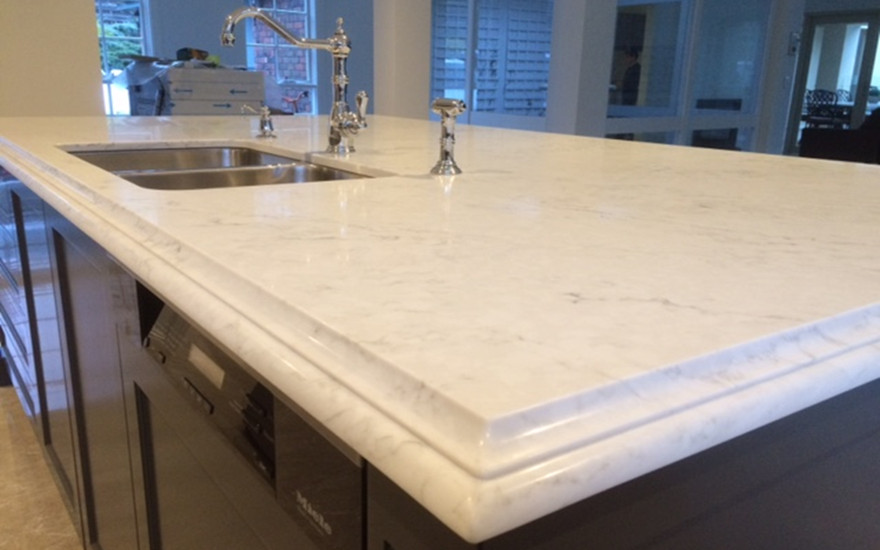
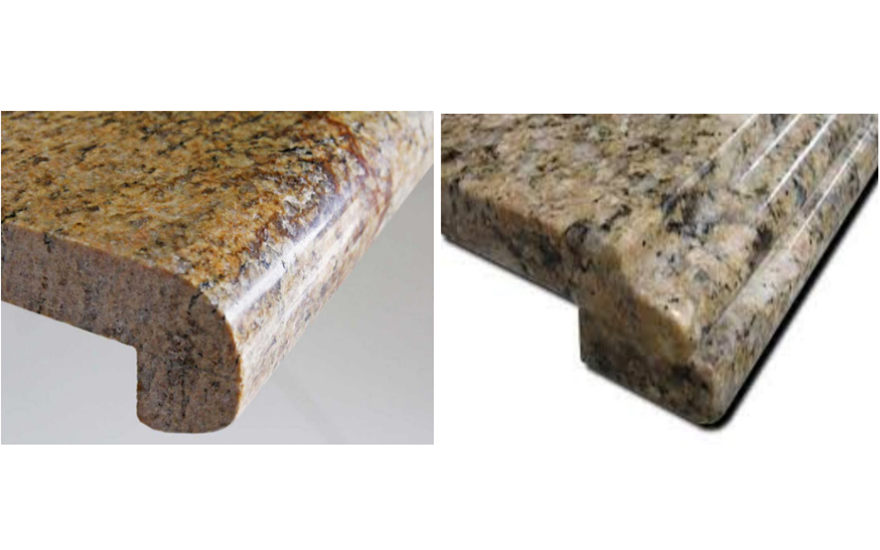
The finished edge may be straight polished, beveled, rounded, profiled or joined at 45 degrees to create a thicker appearance. The required processing route depends on the countertop material, edge design and installation method.
Waterjet cutting is applied when a stone product contains curves, internal openings, detailed patterns or irregular contours that cannot be completed efficiently by straight blade cutting.
The cutting path is controlled according to a digital drawing, allowing the machine to process repeated or customized shapes.
Common stone waterjet applications include:
Countertop sink cutouts
Faucet and drainage holes
Curved countertop sections
Floor medallions
Hotel lobby patterns
Stone inlay designs
Wall decoration panels
Circular stone components
Customized logos
Complex architectural shapes
In countertop fabrication, waterjet cutting can process internal openings and curved paths while reducing extensive manual cutting and grinding.
For flooring medallions and stone inlay work, individual parts must fit together accurately. Consistent cutting paths help reduce visible gaps and improve assembly quality.
Waterjet processing can also be used for projects combining marble, granite, ceramic, glass or metal decorative components. The digital drawing can be stored and reused when the same design is required again.
Cutting parameters should be adjusted according to the material hardness, slab thickness, shape complexity and required edge condition.

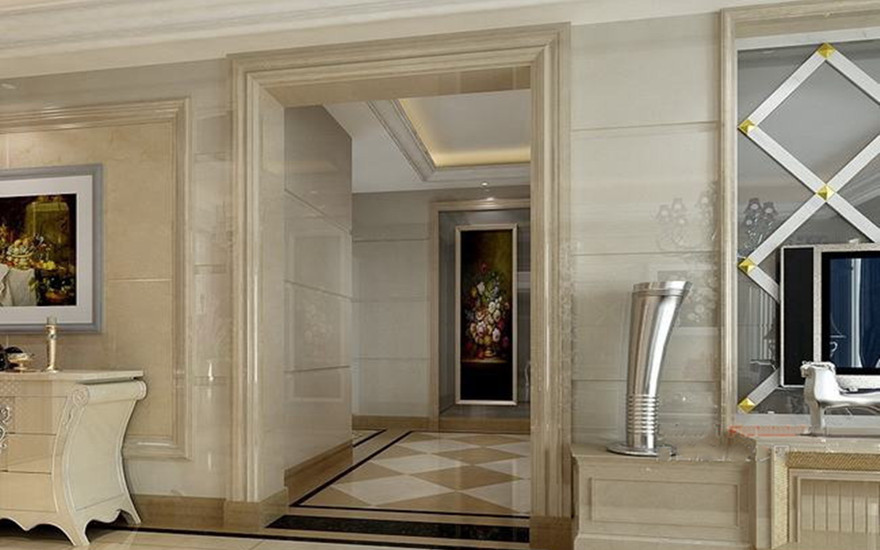
Decorative stone profiles are widely used in luxury residential interiors, hotels, commercial buildings and architectural decoration.
Unlike ordinary straight-edged panels, these products require the stone surface or edge to be formed into a specific profile and then polished to achieve the required appearance.
Typical applications include:
Stone door surrounds
Elevator entrance frames
Window frame profiles
Background wall borders
Decorative wall strips
Column components
Bullnose moldings
Ogee moldings
Roman-style profiles
Architectural stone trim
The processing sequence usually begins with rough profile forming. Additional grinding and polishing stages then remove tool marks and gradually improve the surface finish.
Profile accuracy is especially important when several sections are installed together. Differences in width, curve depth or shape may become clearly visible after installation.
The polished surface should also remain consistent from the beginning to the end of each workpiece. Good decorative molding quality requires both an accurate shape and a uniform finish.
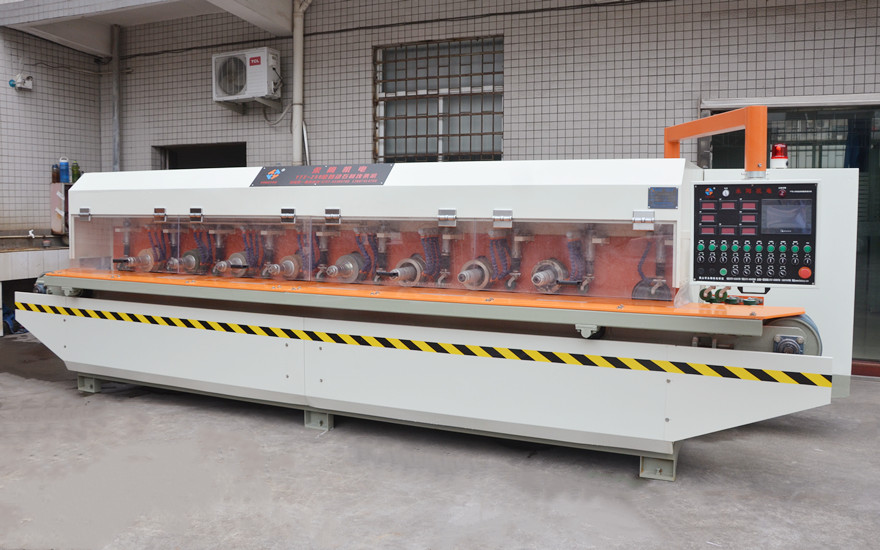
Yongtao YSXP-series stone molding machines are designed for the continuous profiling and polishing of marble, granite, artificial stone and engineered stone decorative lines.
The YSXP-150 and YSXP-250 series can be used for different profile sizes and stone-processing requirements. Multiple processing heads can be configured according to the material, profile complexity, required finish and production capacity.
These machines are suitable for:
Marble door frame lines
Granite decorative strips
Elevator entrance surrounds
Window frame moldings
Background wall borders
Bullnose stone profiles
Ogee decorative lines
Straight architectural moldings
Artificial stone profiles
Customized linear stone products
During production, the first processing stages form the required profile. The following stages complete intermediate grinding, fine grinding and polishing.
Different tools may be used according to the stone material and required surface quality, including profile wheels, resin polishing wheels and finishing wheels.
Marble applications require careful control to reduce edge damage and scratches. Granite applications require stable grinding capability and suitable wear-resistant tools. Engineered stone applications require consistent dimensions and a uniform polished finish.
Combining profile forming and polishing in a continuous process reduces repeated workpiece handling. It also helps maintain more consistent dimensions and surface quality during batch production.
Finished profiles should be inspected for:
Consistent width
Correct profile shape
Uniform curve depth
Continuous brightness
Visible grinding lines
Edge chipping
Differences between both ends of the workpiece
Surface gloss alone does not determine the quality of a stone profile. The shape must also remain accurate and consistent along the complete length.

A stone edge polishing machine is used to grind, shape and polish the visible edges of countertops, vanity tops, tables, window sills, stair components and architectural stone panels.
Common stone edge applications include:
Straight polished edges
Upper bevels
Lower bevels
Half bullnose edges
Full bullnose edges
Ogee profiles
Rounded edges
Concave profiles
Waterfall edges
Laminated thick edges
The processing sequence normally begins with rough grinding to remove material and establish the required geometry. Fine grinding and polishing then improve the edge surface and remove visible tool marks.
The grinding wheel or profile wheel must match the required edge design. A bullnose, ogee, concave or waterfall edge requires a corresponding tool shape and processing adjustment.
Stable feeding is important because changes in workpiece movement can create uneven profiles, visible lines or inconsistent polishing.
The correct application settings depend on:
Stone material
Workpiece thickness
Required edge shape
Grinding depth
Feed speed
Tool pressure
Cooling-water supply
Tool condition
Polishing sequence
These factors should be adjusted together rather than independently. Excessive feed speed may leave visible grinding marks, while excessive pressure may damage the edge or increase tool wear.
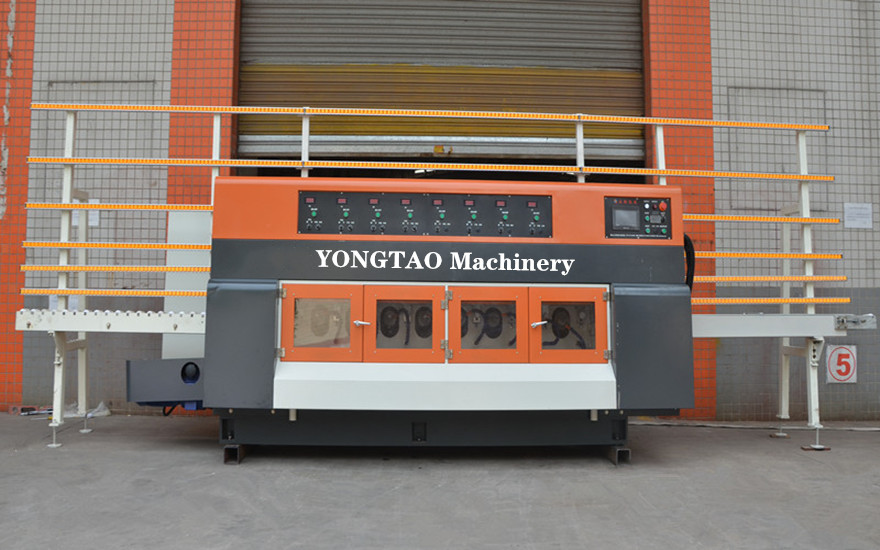
Multifunctional stone edge profiling machines are applied to products requiring shaped and polished visible edges.
A typical machine uses several heads for rough forming and additional heads for progressive grinding and polishing. This allows the edge profile to be completed in a continuous production process.
Suitable applications include:
Kitchen countertop edges
Bathroom vanity edges
Dining table edges
Window sills
Stair components
Thick laminated countertops
Decorative stone panels
Customized stone edge designs
For each application, the selected profile wheel should correspond to the required finished shape.
When a factory changes from a bullnose profile to an ogee, concave or waterfall edge, the tooling and machine settings must also be changed. The stone thickness and required profile depth should be confirmed before production.
Continuous edge profiling can reduce manual grinding and improve consistency when producing several workpieces with the same design.
The final edge should be checked for profile symmetry, straightness, surface brightness, remaining grinding marks and damage around corners.


A stone chamfering machine is used to produce controlled bevels and 45-degree edges for countertop joining, wall-panel assembly, stair components and decorative stone products.
Typical applications include:
Upper-edge chamfering
Lower-edge chamfering
Countertop miter joints
Wall-panel corner joints
Box-shaped countertop edges
Stair-edge preparation
Decorative border processing
Thickened stone panels
In countertop applications, 45-degree edges are commonly joined to create a thicker visual appearance without using a solid thick slab.
The final joint quality depends on angle consistency, edge straightness and the amount of material retained during processing. An uneven bevel can create visible gaps or increase the amount of manual correction required before gluing.
For long workpieces, the bevel width and angle should remain consistent from one end to the other. Stable feeding and suitable blade or grinding-wheel adjustment are therefore important.
A stone polishing machine is used to improve the flatness, smoothness and surface brightness of marble, granite, artificial stone slabs, panels, tiles and decorative components.
Yongtao polishing equipment can be applied to:
Marble slabs
Granite panels
Small stone tiles
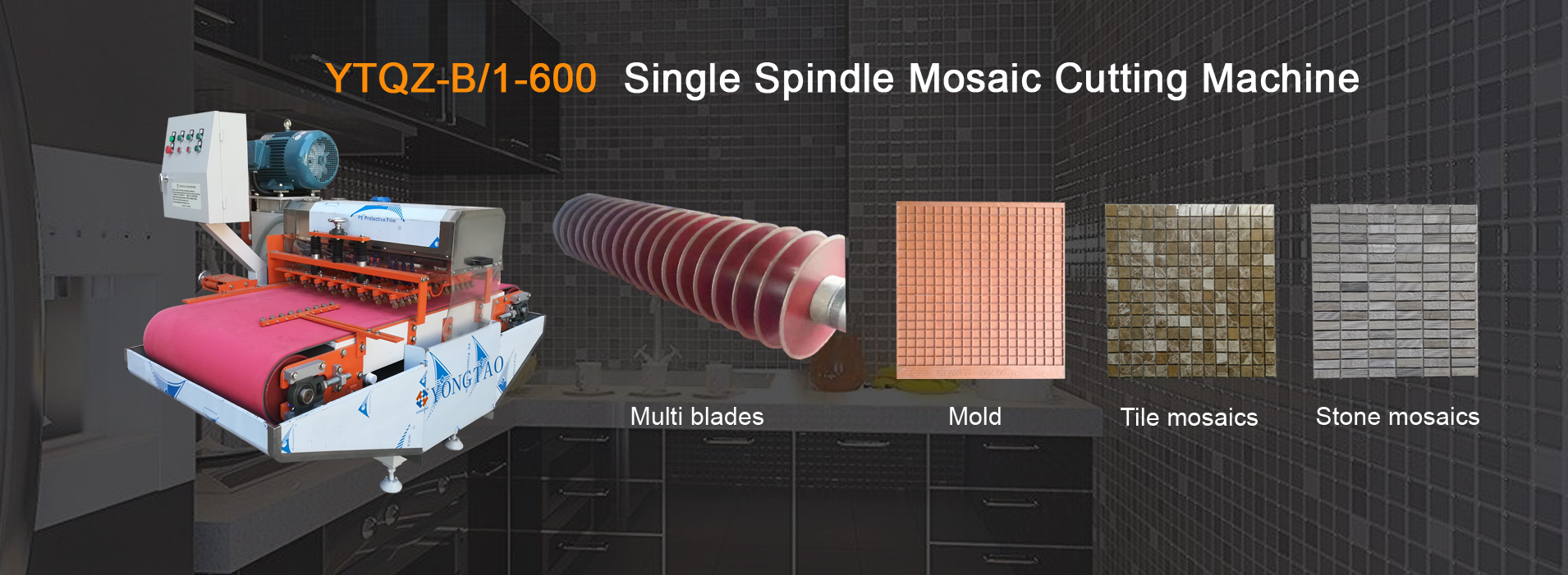
Mosaic pieces
Wall decoration panels
Tabletop components
Architectural stone products
Customized stone samples
The polishing process normally uses several abrasive stages. Coarser tools remove surface irregularities and previous processing marks, while finer tools gradually produce a smoother and more reflective finish.
The correct polishing sequence depends on the material hardness, original surface condition and required gloss.
Stable polishing pressure and consistent machine movement help prevent uneven brightness, surface waves and local over-polishing.
Cooling water also removes grinding residue and controls tool temperature during wet processing.
After polishing, the workpiece should be cleaned and dried before inspection. Water may temporarily hide scratches, polishing lines or differences in surface brightness.
Marble is widely used for interior wall panels, flooring, vanity tops, stair components, door surrounds and decorative profiles.
Typical marble-processing applications include:
Slab sizing
Wall-panel cutting
Vanity-top fabrication
Waterjet inlay cutting
Floor medallions
Door frame production
Elevator frame production
Bullnose profiling
Ogee molding
Edge polishing
Surface polishing
Background wall decoration
Marble is suitable for detailed decorative profiles, but some materials contain natural veins and structurally weak areas.
Cutting speed, grinding pressure and workpiece handling should be controlled to reduce broken corners and damage along natural veins.
Surface protection is also important because scratches and stains may reduce the appearance of high-value marble products.
Granite is commonly used for kitchen countertops, exterior panels, flooring, stair steps, tables and architectural components.
Typical granite-processing applications include:
Countertop cutting
Sink openings
Faucet holes
Straight edge polishing
Bullnose edge processing
Stair-step production
Window-sill production
Wall-panel cutting
Decorative granite profiles
Customized architectural shapes
Granite is harder and denser than many marble materials. Its processing requires stable machine construction, suitable diamond tools, controlled feeding and sufficient cooling.
During edge and profile processing, excessive vibration may create visible marks or reduce dimensional consistency.
Granite production should therefore be evaluated according to long-term processing stability, tool performance and finished quality rather than cutting speed alone.
Quartz and engineered stone are widely used for residential and commercial surfaces.
Common applications include:
Kitchen countertops
Bathroom vanity tops
Island counters
Dining tables
Reception desks
Commercial worktops
Sink cutouts
Faucet openings
Straight polished edges
Profiled edges
45-degree joined panels
These products normally require accurate dimensions because the finished components must fit cabinets, walls, sinks and appliances.
Quartz countertop fabrication may include straight cutting, CNC or waterjet cutout processing, edge polishing and miter processing.
Depending on the design, the edge may be straight, rounded, beveled, laminated or shaped into a decorative profile.
Wet processing, water circulation and slurry collection should be considered when organizing the production area. A logical processing sequence also helps reduce unnecessary slab movement between operations.
Stone-processing equipment is widely applied to architectural projects that require both functional performance and decorative appearance.
Typical applications include:
Hotel lobby flooring
Commercial entrance areas
Elevator surrounds
Building wall panels
Door and window surrounds
Reception areas
Luxury residential interiors
Retail-store decoration
Restaurant countertops
Customized project components
Architectural stone products often pass through several operations, including cutting, profiling, polishing, inspection and trial assembly.
For wall panels and continuous decorative lines, dimensional consistency is especially important. Small variations may become visible when several pieces are installed next to each other.
For patterned flooring, waterjet inlay and customized wall designs, cutting accuracy affects the joint width and overall visual quality.
Each completed part should be clearly identified before packing to support correct installation at the project site.
Yongtao stone processing equipment can support the production of:
Kitchen countertops
Bathroom vanity tops
Island worktops
Dining tables
Bar counters
Reception desks
Stair steps
Window sills
Wall cladding panels
Flooring panels
Stone door frames
Elevator surrounds
Decorative molding lines
Bullnose profiles
Ogee profiles
Background wall borders
Stone medallions
Inlay patterns
Mosaic components
Customized architectural stone
Different products require different machine applications. A decorative molding factory focuses on profile forming and polishing, while a countertop factory places greater emphasis on dimensional cutting, sink openings and edge finishing.
The quality of a finished stone product depends on more than the machine itself.
Important processing factors include:
Correct machine application
Suitable cutting and grinding tools
Stable workpiece feeding
Accurate positioning
Controlled processing speed
Sufficient cooling water
Regular tool inspection
Correct polishing sequence
Careful material handling
Final product inspection
Before processing a new product, the factory should confirm the material, dimensions, thickness, required shape, edge design and surface finish.
Photos, samples and technical drawings help determine the correct processing method. Testing with the actual material is also useful when the stone has unusual hardness, veins or surface requirements.
Yongtao supplies industrial stone machines for shaping, edge processing, surface finishing and customized stone fabrication applications.
Our application support can cover:
Stone slab cutting
Countertop fabrication
Waterjet openings and patterns
Straight profiling and polishing
Edge grinding and polishing
Stone chamfering
Surface polishing
Decorative molding production
Customized processing requirements
Overseas electrical configuration
Installation and commissioning
Operator training
Tooling and spare-parts support
The purpose of application analysis is to confirm whether the machine, tooling and processing sequence are suitable for the customer’s actual stone product.
Instead of selecting equipment only by machine model, Yongtao evaluates the raw material, finished shape, dimensions, required quality and production conditions.
Every stone product has different processing requirements. The suitable application depends on the stone material, dimensions, cutting path, edge profile, surface finish and expected production quantity.
Customers can provide a stone sample, product photo, technical drawing or processing video. Yongtao will evaluate the required operations and recommend a suitable equipment configuration for marble, granite, quartz and customized stone production.
0086-18665475362
[email protected]
Road 3, Wuzhuang Xiaofengtian Ind. Zone, Luocun Town, Nanhai Dist., Foshan, Guangdong, China